

The C-Note | A Supreme Undermining of Black Political Power (May 4 Edition)
The Supreme Court ruling weakening Black voting power, rising gas prices, a deadly outbreak at sea, and the Met Gala spotlight.

“Fear is the path to the dark side. Fear leads to anger. Anger leads to hate. Hate leads to suffering.” — Yoda, Star Wars: Episode I – The Phantom Menace
The “C-Note(able)”
The story shaping the moment.
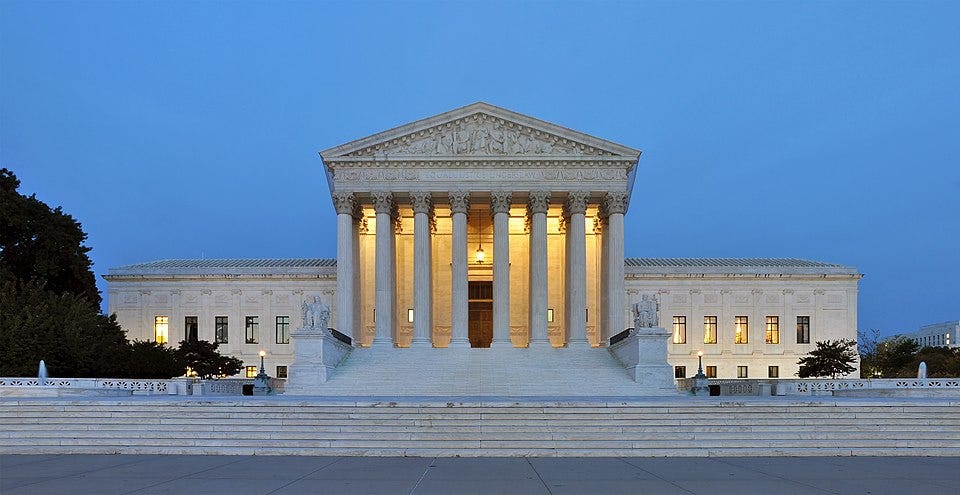
Last week was a gut punch for Black Americans. As a Black woman born and raised in the Deep South, it hit hard — but it didn’t surprise me.
The Supreme Court’s latest decision will not only reshape American democracy but also effectively disenfranchise Black voters.
How?
By gutting key protections under Section 2 of the Voting Rights Act of 1965, which has long been used to challenge racial discrimination in voting, including maps that dilute the political power of Black voters and other communities of color.
For decades, Section 2 allowed voters and civil rights groups (and the Justice Department) to sue when district lines or election practices made it harder for communities of color to elect representatives of their choice. But Justice Samuel Alito’s opinion asserts that a Section 2 violation occurs only with evidence of "intentional discrimination," rather than showing a discriminatory result — making it much harder to prove discrimination.
The latest decision could lead to a significant drop in Black representation in Congress, putting at least 15 House districts at risk, according to my NPR colleague Hansi Lo Wang. And these districts are primarily in the South.
While some argue the ruling will not immediately impact the 2026 midterm elections, the ripple effects are already beginning. Just like that, states are moving quickly, especially in the South.
Louisiana Gov. Jeff Landry, a Republican, has suspended the state’s May 16 primary elections as lawmakers reconsider congressional maps — a move that could ultimately reduce the number of Black-majority districts. In Alabama, Gov. Kay Ivey, also a Republican, has called a special session in the legislature that meets today, aiming to delay the May 19 primary to draw a new congressional map. Tennessee Gov. Bill Lee, another Republican, is convening the state’s legislature on Tuesday to do the same ahead of the state’s August 6 congressional primary elections.
The implications of the SCOTUS ruling go far beyond Black voters. Advocates say communities of color across the country will feel the effects.
Juan Proaño, CEO of the League of United Latin American Citizens (LULAC), said the six conservative Supreme Court justices gave a green light for racially discriminatory maps.
“This is a deliberate decision to weaken the political power of 70 million Black and Latino eligible voters in a nation that grows more diverse every single day. Politicians should not choose their voters, voters should choose their politicians,” he said.
Proaño added, “Latinos are 14.7% of the American electorate. We are not going away, we are not going to be silenced, and we are not going to be written out of American democracy by judicial fiat. The Court has chosen its legacy today. We will choose ours."
Bethany Li, executive director of the Asian American Legal Defense and Education Fund, said the ruling “deepens long-standing barriers to fair representation” for Asian American communities.
“Our communities are too often ignored, divided, or excluded through redistricting and other voter suppression tactics, despite our growing numbers and civic engagement,” Li said. “This administration continues to cut entire communities out of the fabric of this country, resulting in a continued loss of political voice for communities like ours.”
The Native American Rights Fund and the National Congress of American Indians warned the decision could “embolden racial discrimination against Native voters.”
“When a Tribal Nation or Native American community’s political voice is diluted, so is its ability to secure good schools, adequate infrastructure, health care access, environmental protections, and economic opportunity,” the organizations said. “Taking away voting protections, like what happened with today’s decision, makes it harder — and at times impossible — for Native voters to elect representatives who will respond to their needs.”
The conservative majority court’s ruling may be framed as a “legal decision,” but the SCOTUS has steadily chipped away at the VRA. Last week’s ruling is the latest signal of where we are as a country. Because, as my mantra goes: “Pay attention to a person’s feet, not their mouth.” The direction this country is headed tells you everything you need to know.
Meanwhile…
Here’s What Else to Note…
Other headlines worth keeping on your radar.
If you don’t own a bicycle, now is the time to invest in one. As I reported for NPR this weekend, gas prices have gone up more than 30 cents in the last week and will continue to rise. President Trump says gas prices will “drop like a rock” when the war in Iran ends but experts say that isn’t so. Read more of my reporting here.
🚨 An outbreak of the hantavirus, a deadly disease transmitted by infected rodents, has killed at least three people on a cruise ship in the Atlantic Ocean, according to the World Health Organization.
The Wallis Annenberg Wildlife Crossing, a northern Los Angeles County bridge to help wildlife escape wildfires over the ten-lane freeway, is scheduled to open Dec. 2, 2026.
A portion of East Africa is going to break up into a second continent and create a new ocean faster than originally thought, according to scientists.
Get yours before it sells out…🌕 The adorable Artemis II “Rise” plushie, designed by 8-year-old Lucas Ye, is now available for purchase. It can be bought here and NASA notes that delivery can take up to 8 weeks due to “extended production time.”
The Met Gala is tonight at 6:00 p.m. ET. Beyoncé, Nicole Kidman, Venus Williams, and Anna Wintour are co-chairs this year. The dress code is “Fashion is Art.”
Before you go about your day…
A Personal Note:
A reflection to take with you this week.
“I will make it regardless of what happens. Not because the path is easy but because I am resilient. I am still standing. And as long as I’m standing, I’m not finished.”
